
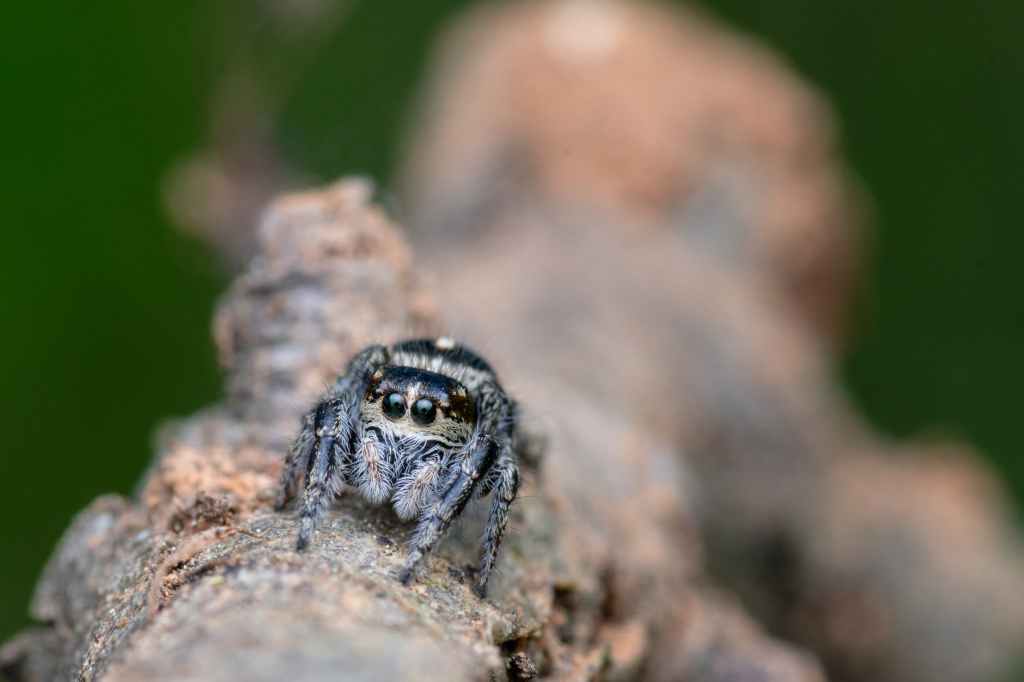
Look at this cute little dude. He is NOT the subject of today's rant.
Let’s talk about Dracula.
No, not the character. The book.
More specifically, a single line in the book, spoken by the great and extremely convenient character of Abraham Van Helsing:
“Can you tell me why, when other spiders die small and soon, that one great spider lived for centuries in the tower of the old Spanish church and grew and grew, till, on descending, he could drink the oil of all the church lamps?”
Wait, wait, wait. Hold up. What?
Please note that I read (technically I listened to the Audible version) this book four years ago, in 2017. As such, my memory on it might be a little hazy.
If I remember correctly, I think good ol’ Abraham was trying to convince that vampires could conceivably exist by stating a bunch of other outrageous facts that apparently do. And if those things can exist, then so can vampires. Sound logic.
But it was at this exact line in which I dropped all other concerns about the book’s main antagonist, and in fact, his whole species. I rewound the line several times to relisten to it, trying to figure out if I had just heard Abe correctly.
Apparently, somewhere in the world, there was a spider who lived for centuries and was apparently big enough that it could drink all of the oil from every single lamp in a certain church. Which honestly, even if that was only one lamp, that’s still too much for any decent, God-fearing spider to be able to drink.
Why are we worrying about vampires when this monster is out there at large? This is the thing we need to be worried about, not Drac. Who gives a crap about Mina? Let him have her, I’ve got more important things to focus on.
How can you just name drop this horrendous beast and just go on with your day, Abe? This needs to be looked into further. We need to gather up a team and head off to Spain to send this thing back to the pit in hell that it crawled out of.
Did Bram Stoker invent this line himself? It was such a weird and extremely specific statement. I had to look more into it, if nothing else, than to maybe find someone who had studied the text and could explain a little more about this one throwaway sentence. But what I found was actually the blog of a cryptozoologist. He, quite understandably, had the same questions I did, and set about researching said abomination against God and nature. (That blog post here)
He goes into a bunch of details that you can read for yourself if you want, but the one thing I want to focus on is this story that was shared in 1821 in the periodical The Edinburgh Magazine and Literary Miscellany:
“The sexton of the church of St Eustace, at Paris, amazed to find frequently a particular lamp extinct early, and yet the oil consumed only, sat up several nights to perceive the cause. At length he discovered that a spider of surprising size came down the cord to drink the oil. A still more extraordinary instance of the same kind occurred during the year 1751, in the Cathedral of Milan. A vast spider was observed there, which fed on the oil of the lamps. M. Morland, of the Academy of Sciences, has described this spider, and furnished a drawing of it. It weighed four pounds, and was sent to the Emperor of Austria, and is now in the Imperial Museum at Vienna.”
I need to see this drawing. Now. And where is the museum exhibit with this stuffed spider, hm?
Apparently, some dude named W.S. Bristowe looked into the story as well, and mentioned it in a book he wrote. Now, I have not read this book, but the blog post mentions it, saying, “In any event, I deem it highly unlikely that a preserved 4-lb spider exists in any museum collection within Austria — after all, as Bristowe pithily observed in his own coverage, it would be as big as a pekingese dog!”
This, dear readers, is where Harry Potter comes into play.
In the Harry Potter series, Hagrid received an acromantula egg that hatched into Aragog, a truly horrible beast that I am glad died. An acromantula is an enormous spider which, inexplicably, can speak human. That’s beside the point here, it’s just weird.
Anyway, in Harry Potter and the Half-Blood Prince, Hagrid, after the funeral of Aragog, makes this statement: “I had him from an egg, yeh know. Tiny little thing he was when he hatched. ‘Bout the size of a Pekingese.”
Pekingese
In both instances, that is a very specific breed of dog to use as a size reference.
By the way, pekingese dogs weigh much more than four pounds, at least in my experience. Unless perhaps they’re referring to those awesome sleeve dogs they used to have in China. But whether or not a pekingese actually weighs four pounds is not the main concern here. Four pounds is too much for any spider to weigh, and even the smallest dog in existence is too dang big for a spider to attempt to copy.
Now, first off, it could be argued that the 1821 story was completely fabricated by the church guy who had been under suspicion of stealing the oil from the lamps, and he randomly decided to pull up a previous story about a giant spider from under his robe and claim that the same had happened there, because somehow that would be more believable than that he’d been dipping into the oil himself. Second off, it could also be argued that J. K. Rowling, who is notorious for putting immense amounts of research into her works, came across this old account and decided to use this as inspiration for Hagrid’s throwaway line here.
If you are the kind of person who would make either of these arguments, get the heck out of my blog. We don’t deal in that sort of logical nonsense around here, got it?
Now, to get to the real meat of my theory.
The 1821 account was printed in real life.
It was quoted by Abraham Van Helsing in the story Dracula (Mind you, he got the facts wrong, but I don’t blame him for misremembering the details. He’s obviously got vampires on the brain. Besides, if he were a more sensible person, he’d have become a spider hunter on hearing this news instead of a vampire hunter. The fact that he did not do this proves that his cornbread ain’t done in the middle. So no, I don’t blame him for forgetting the minor details).
Aragog was mentioned specifically as being the size of a pekingese when he hatched, and I can only assume that that’s the normal size for any newly hatched acromantula.
Therefore, I believe that the four-pound cathedral spider was, in fact, a baby acromantula, proving that both Harry Potter and Dracula take place in the same universe.
And if you wanna take it even farther, because an article which mentions a baby acromantula was printed in real life, then that means that we are living in the same universe that both Harry Potter and Dracula take place in. Which is altogether wonderful (because magic, duh), horrifying (because vampires and, even worse, giant spiders), and sad (because it means that I am a muggle. Or no-maj, since I live in North America. However, if I’m not magic, I at least wanna be called a muggle instead of a no-maj, because no-maj sounds stupid).
Now, one last thing. If the four-pound spider was in fact a baby acromantula, then that means that it would have grown up and become even more horrible, giving even more fuel to the argument that someone needs to go take care of this thing.
I, for one, nominate Renfield.
 M. A. Whatley